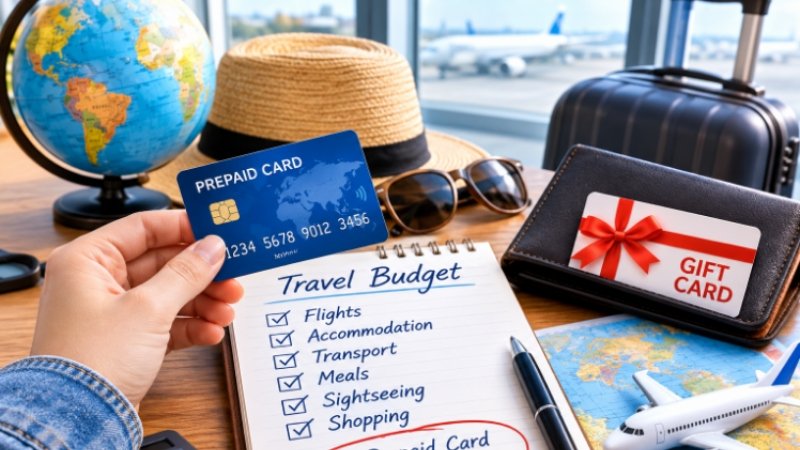
There is a version of travel budgeting that consists of a spreadsheet made three months in advance and abandoned on day two. There is another version that consists of choosing payment instruments carefully enough that the budget largely enforces itself. The second version works considerably better, mostly because it does not depend on discipline in a foreign city at the end of a long day.
Prepaid cards and stored balances are the main tools for this approach. Their defining characteristic — you cannot spend more than is loaded — is exactly the property that makes budgeting self-executing. Used well, they turn a category of daily decisions into a single decision made once, at home, when you were thinking clearly.
Why Prepaid Instruments Suit Travel
The primary advantage is containment. A prepaid card loaded with a trip’s discretionary budget cannot overspend that budget. This sounds obvious and is nonetheless transformative in practice, because travel overspending is rarely a single large decision. It is forty small ones, each individually defensible, compounding into a number that surprises you when the statement arrives. A hard ceiling removes the compounding without requiring any willpower at the moment of purchase.
The second advantage is exposure limiting. Carrying a card that accesses your primary account means a lost or compromised card exposes your primary account. A prepaid card exposes only what is loaded. For travel in unfamiliar environments, or for use at merchants and machines you cannot vet, this is a meaningful reduction in the worst-case outcome. Many experienced travelers carry a prepaid instrument for daily use and keep primary cards secured for large or trusted transactions only.
The third is separation of accounting. Loading a defined amount for a defined trip means the trip’s total cost is knowable without disentangling it from ordinary monthly spending. For anyone who wants to know what a holiday actually cost — and to plan the next one accordingly — this is worth more than any budgeting app.
The Costs and Limitations
Prepaid instruments are not free, and the fee structures deserve scrutiny before departure rather than discovery afterward.
Loading fees, which may be flat or percentage-based, apply at the point of adding funds. Foreign currency conversion is the big one: the spread applied to conversion varies dramatically between issuers, and a poor rate can quietly cost several percent of everything you spend abroad. ATM withdrawal fees apply per transaction, sometimes on both the card and the machine side. Inactivity fees erode balances left on a card after the trip. And unloading — getting remaining money back off the card — is often the most expensive and least publicized step.
Practical limitations matter too. Some prepaid cards are declined for hotel and rental car holds, which place an authorization well above the actual charge. Some are not accepted at automated fuel pumps or ticket machines. Reloading from abroad is sometimes restricted. Checking these specifics against your actual itinerary takes fifteen minutes and prevents the failure mode where the budgeting instrument does not work in the exact situations that matter most.
Gift Balances and Trip Planning
Gift cards occupy a different role. They are less useful as a general travel instrument because they are merchant-restricted, but they are genuinely useful in two situations.
The first is pre-trip purchasing. Airlines, hotel groups, booking platforms, and large retailers all issue stored value, and using accumulated balances against flights, accommodation, or gear reduces the cash cost of the trip at full face value. This is the highest-return use of any stored balance: no conversion, no discount, no fees. The constraint is that the balance must match something you were going to buy anyway. Buying a more expensive flight to use a balance is not saving money.
The second is disposing of balances that will never match a travel purchase. A card for a regional retailer with no relevance to your trip is not going to help. Where the balance is genuinely unusable, converting it into flexible funds is a reasonable option, though it always costs something — services like dreamgift operate in this space in the Korean market, and comparable operators exist in most regions. The principle to hold onto is that conversion should be a last resort after spending and gifting have been exhausted, because it is the only route that does not return full value.
Building the System
A workable structure looks roughly like this. Decide the total trip budget at home. Then set the daily discretionary figure by dividing the loaded amount by trip days. The card enforces the total; you enforce the daily pace only loosely. Front-loading spending early in a trip is the most common pattern, so a light awareness of the running total in the first few days is worth the small effort.
Note the customer service contact for the prepaid issuer before leaving. Because finding it afterward while abroad and cardless is unpleasant.
Finally, plan the exit.